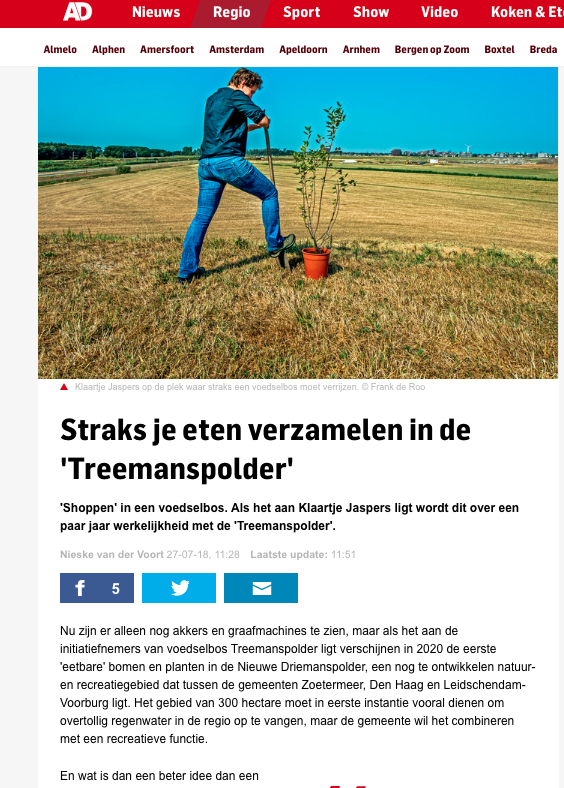
Lees het volledige artikel in het AD

Lees het volledige artikel in het AD
Zoetermeer Actief, 16 juni 2018, ‘Zelf eten plukken in nieuw voedselbuurtbos‘
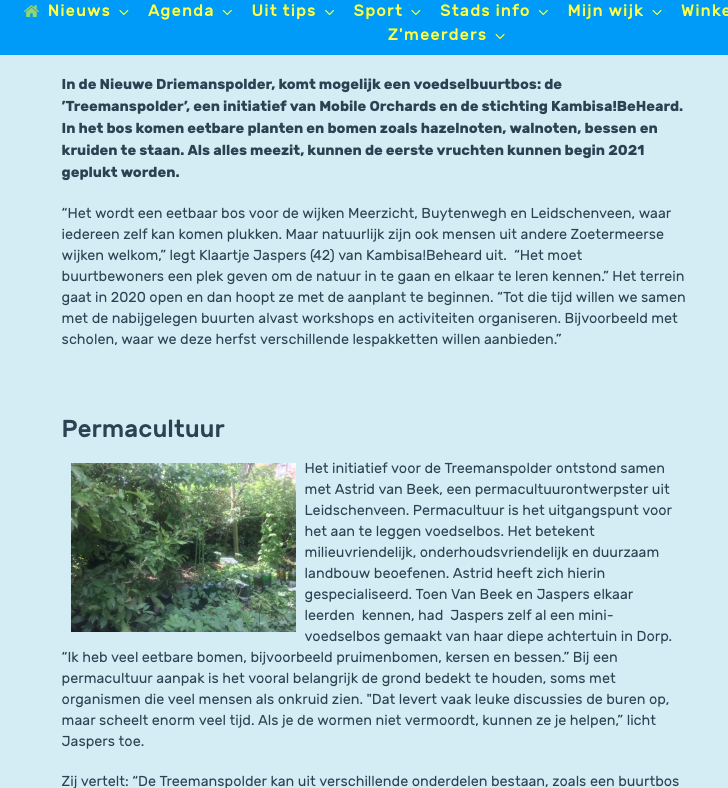
Lees het volledige artikel op Zoetermeer Actief
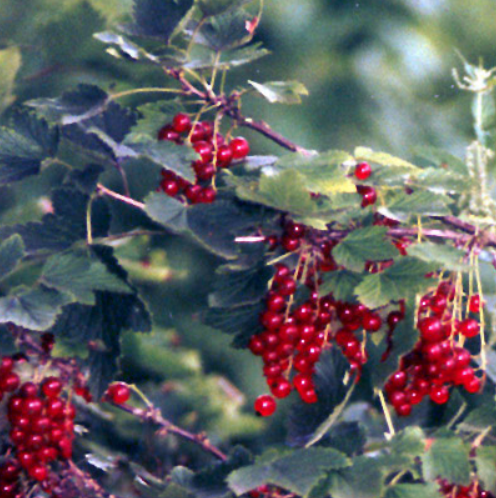
De zomerbestellijst voor Lease a Tree is uit! We hebben o.a. nog aalbessen en appelbessen, met verschillende kruiden die eronder horen. Voor 8 Euro heb je al een eetbare struik die je later weer in mag ruilen, of met een naambordje in het toekomstige voedselbuurtbos kan planten. Voor 13 Euro heb je al een set met een struik en twee soorten onderbeplanting. Wil je meer, of iets anders? Laat het ons weten!
Binnenkort komt ook de winterbestellijst voor Lease a Tree uit, de keuze zal dan veel groter zijn. Daarmee kan je bijvoorbeeld ook oude fruitboomrassen bestellen. Als je ze voor september bestelt, krijg je ze geleverd in de herfst, in een kant en klare combinatiezak, of als een set die je zelf in de volle grond kan zetten.
Over smaak valt niet te twisten. Onze smaakbeleving is niet alleen genetisch bepaald en leeftijdsgebonden, weet Dr. Evelien Rozema, maar bijvoorbeeld ook afhankelijk van onze darmen en onze neus. Tijdens het tweede deel van haar cursus in de Leidse Hortus Botanicus, nam de fytochemicus deelnemers mee op een zoektocht naar gezonde zoethoudertjes.
Vroeger leerden we dat de vier basissmaken zoet, zuur, bitter en zout alleen door bepaalde delen van de tong worden herkend, vertelt dr. Evelien Rozema, maar inmiddels wordt duidelijk dat er ook smaakreceptoren achter in de mond en keelholte zitten. Zoetreceptoren zijn een complex van twee eiwittten T1R2 en T1R3 genoemd. Deze receptoren zijn zelfs in maag en darmen aanwezig waar ze invloed hebben op de stofwisseling.
Tong, mond, keel, maag en darmen
Bovendien zijn er niet vier basissmaken, maar minstens vijf. De Japanse professor Ikeda ontdekte al in 1908 een vijfde smaak, die hij umami (‘hartig’) noemde. Umami versterkt zoete en zoute smaken en komt voor in etenswaren die veel glutamaat bevatten, zoals tomaten, champignons, vlees en zeewier. Pas in 2000 werden glutamaatreceptoren op de tong ontdekt en werd Ikeda’s ‘umami’ als vijfde basissmaak erkend.
Van de basissmaken, leveren ‘zoet’ (snoep) en ‘bitter’ (spruitjes) vaak de meeste discussie op. De smaak bitter wordt al sinds de oertijd geassocieerd met bedorven of giftig voedsel. Om ons te waarschuwen proef je bitter dus ook al in lage concentraties. De gemiddelde Westerse consument houdt daar echter niet van, dus wordt de specifiek bittere smaak van groentes als witlof en spruitjes er consequent uitgeselecteerd.
Zoethoudertjes
Veel mensen neigen juist naar zoete dingen, hoewel ze weten dat de suiker waar ze die in vinden, vaak niet goed voor hen is. Zoetekauwen zoeken naar alternatieven om de nadelige gevolgen van suiker te ontwijken. Verkopers spelen daar slim op in door vermeende verschillen tussen de soorten suikers te benadrukken. Discussies over riet- of bietsuiker zijn echter onnodig, weet Rozema, want chemisch gezien zijn beide soorten hetzelfde. In beide suikers zit voornamelijk hetzelfde molecuul: sucrose.
Wie een alternatief zoekt voor deze geraffineerde suikers kan beter niet kiezen voor zoethout of agavesiroop, waarschuwt de fytochemicus: zoethout verhoogt de bloeddruk en agavesiroop bestaat voor ca. 90% uit geraffineerde fructose. Het mist de gezonde vezels en mineralen van fruit, en fructose is zeer slecht voor je lever.
Tian-cha en stevia
Een beter alternatief is te vinden in stoffen die zoet smaken, zonder daarbij de nodige calorieën te leveren. Stoffen die de werking van de zoetreceptoren remmen of de smaakbeleving veranderen, zouden de behandeling van diabetes en obesitas kunnen helpen. De meest bekende komt van de plant Stevia rebaudiana, die al eeuwenlang in Paraguay gebruikt wordt om het eten en drinken te zoeten. Steviolglycosiden zijn tot 300 keer zoeter dan tafelsuiker, maar het stevia heeft wel een nasmaak.
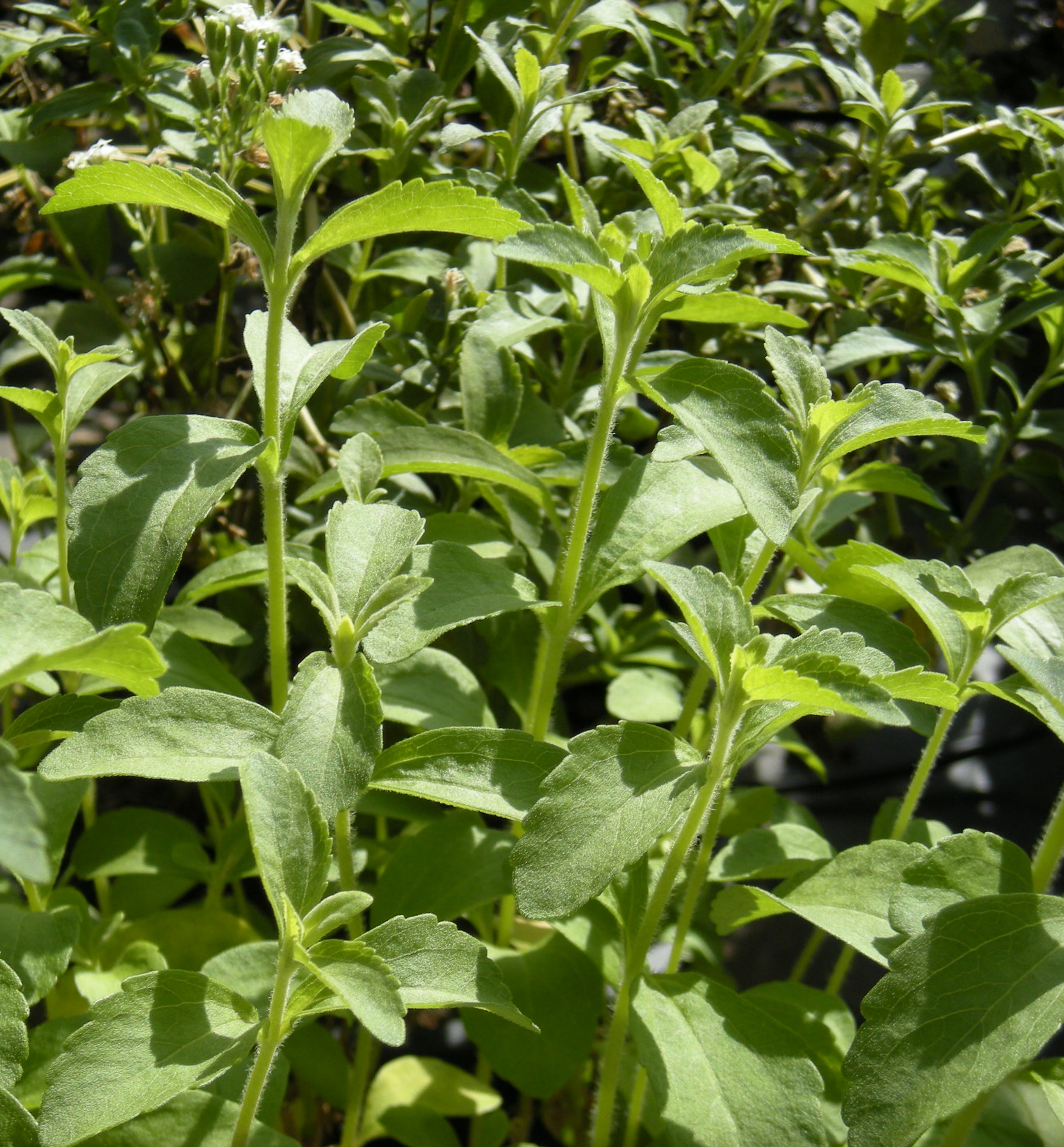
In de Chinese Kruidentuin van de Hortus Botanicus Leiden deelt Rozema stukjes van het bramenblad van de Chinese braam uit. Het stukje blad geeft een echte zoete smaaksensatie door de aanwezige steviolglycosiden. In China wordt hier een traditionele kruidenthee van gebrouwen: Tian-cha.
Wonderbes
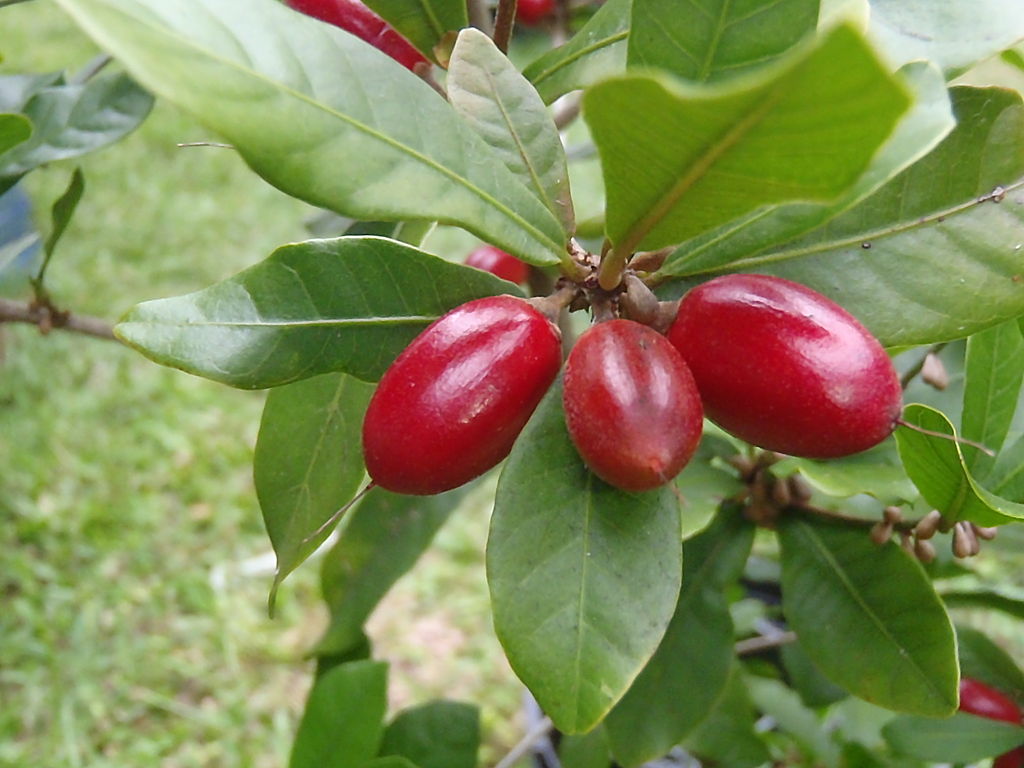
Sommige stoffen kunnen de smaakreceptoren flink in de war brengen. Bij het eten van artisjok, bindt de stof cynarine bijvoorbeeld tijdelijk de zoetreceptor, zodat je glas wijn opeens vreemd zoet kan smaken. Nog vreemder is het effect dat het eten van de West-Afrikaanse mirakelbes teweegbrengt: het eiwit miraculine in de wonderbessen zorgt dat zure stoffen ongeveer een uur lang zoet smaken.
foto’s: Miracle berry by Hamale Lyman CC0, Stevia rebaudiana foliage by Ethel Aardvark CC3.0
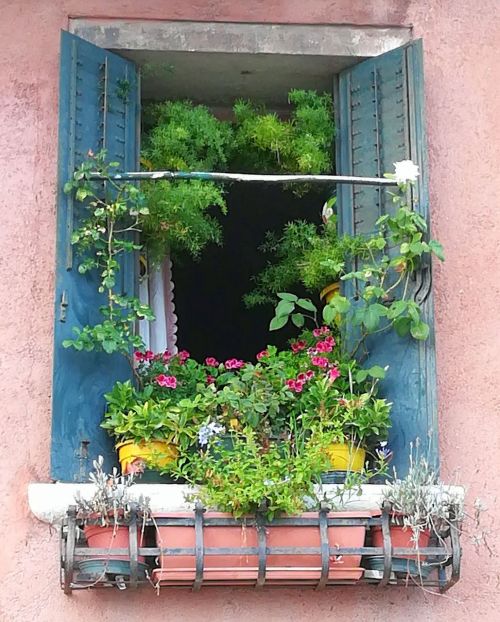
Of je nu in een wolkenkrabber of een sloppenwijk woont, iedereen zou een boomgaard moeten hebben. Ze voeden mensen, ze geven je zuurstof om te ademen en een levende voorraadkast om magere jaren te doorstaan. Ze houden de grond vast waarop we leven, voeden de bijen die ons voeden. En als je ze op een creatieve manier gebruikt, kunnen ze je zelfs beschermen tegen nieuwsgierige blikken of ongewenste bezoekers.
Enkele voordelen van (eetbaar) groen in overvolle ruimtes:
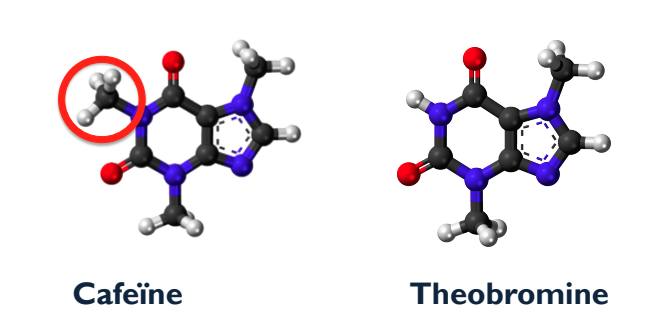
Van grapefruitschil kan je insectenspray maken en cacao bevat bijna dezelfde stoffen als koffie, behalve dat ene stofje dat je ontspannen maakt in plaats van alert. Als fytochemicus weet doctor Evelien Rozema precies welke stoffen in welke planten de gezondheid van de mens kunnen bevorderen. In een vierdelige cursus in de Leidse hortus neemt ze de deelnemers mee op haar tocht door het plantenrijk.
Het theobromine uit de cacaonoot werkt ook tegen hoest, dus neem vooral wat pure chocolade bij een verkoudheid. Maar geef het niet aan je kat: een dosis waar een mens gelukkig van wordt, kan voor je huisdier heel giftig zijn.
Het verschil tussen de chemische structuur van koffie en cacao is echt heel klein, vertelt Evelien naast een Ghanese cacaoboom in de warme kas van de hortus botanicus. In cacao zit theobromine (letterlijk: ‘drank van de goden’) en in koffiebonen cafeïne. Het verschil is een kleine zijgroep met een groot effect op de werking: cafeïne blokkeert de adenosine-receptor in de hersenen, die ons zou moeten waarschuwen dat we moe zijn, theobromine verwijdt bloedvaten.
Eet kleur
Het steekt nogal nauw, in de wereld van de fytochemie. Eerder die ochtend heeft Evelien de veelal nietsvermoedende deelnemers al uitleg gegeven over primaire en secundaire metabolieten: stoffen die de plant simpelweg nodig heeft om zichzelf in leven te houden en stoffen die het nodig heeft om andere soorten tot bepaald gedrag te verleiden. Denk aan de stekels die hongerige planteneters op afstand moeten houden, of aan de aanlokkelijke kleurtjes die dieren juist moeten overhalen rijpe vruchten te eten en hun zaden te verspreiden.
Juist in die tweede categorie heeft de mens heel wat te zoeken. Denk aan het lycopeen dat tomaten rood maakt of het bètacaroteen dat de bekende supermarktwortel zijn oranje kleur geeft: sterke antioxidanten die de mens helpen ongenode indringers op afstand te houden. Niet voor niets adviseren voedingsdeskundigen om veel kleur op je bord te leggen: wie het groen van zijn komkommer schilt, verwijderd daarmee ook een belangrijke bron van vitamine K. Kleur is gezond … als je weet wat je eet. Want onder de oersoorten van pompoen, vind je bijvoorbeeld ook veel giftige. En ook wie zelfgekweekte komkommers met hittestress eet, kan nog altijd ziek neervallen. De bittere smaak verraadde het al – ‘eet mij niet’, zei een secundaire metaboliet.
Waterbom
Omdat niet iedereen Komkommers spreekt, legt de mens zich al duizenden jaren toe op het selecteren van soorten die ons goed van pas komen. Zo werd de banaan een groot geel ding, en kan men in de supermarkt pitloze druiven kopen, al zouden zulke veredelde soorten een wild bestaan nooit overleven. De mens wil gezond, lekker en makkelijk, de markt wil een geconcentreerde oogstperiode, met onkwetsbare, gelijkvormige vruchten die onderweg nog afrijpen.
Dat je met het wegselecteren van ongewenste eigenschappen ook goede eigenschappen verliest, bewijst de watertomaat. Lange tijd werd het Nederlandse kasprodukt gezien als een smaakloos rood zakje water, bewijs van een produktiesysteem dat zo ver doorgeslagen was dat het de oude tomaat geen eer meer aan deed. Bovendien leidt de grootschalige monocultuur tot kwetsbaarheden voor schimmels en ziektes – als een boer 1 ziekte op 10.000 planten had, kon hij gelijk de hele boel weggooien. Dat had voorkomen kunnen worden door een veld vol genetische diversiteit neer te zetten.
Terug naar oer
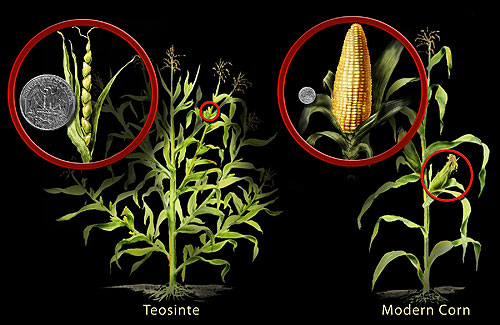
Om zulke problemen op te vangen, weet Evelien, worden veel van de gedomesticeerde soorten tegenwoordig weer gekruist hun oude voorouders. Oersoorten als teosinte, een verre voorouder van de huidige mais, een kleine soort met veelkleurige harde korrels, blijken opeens nieuw nut te hebben. Willen we onze toekomstige voedselvoorraad beschermen, dan moet we terug naar het verleden.
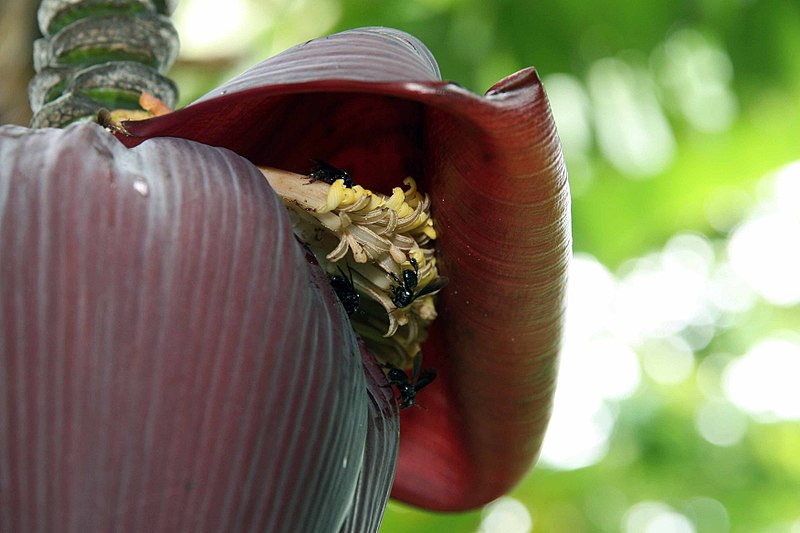
I recently found out one of my friends never heard of purple bananas. That is a pity, because according to me, these Musa acuminata taste much better and they are sold by nicer people than their well-known yellow counterparts, and according to Wikipedia, they contain more beta carotene and vitamin C as well. Unfortunately, they may be just as prone to the feared Panama-disease as their famous Cavendish-cousin, so you might find out one day, they’re all gone – death by infection.
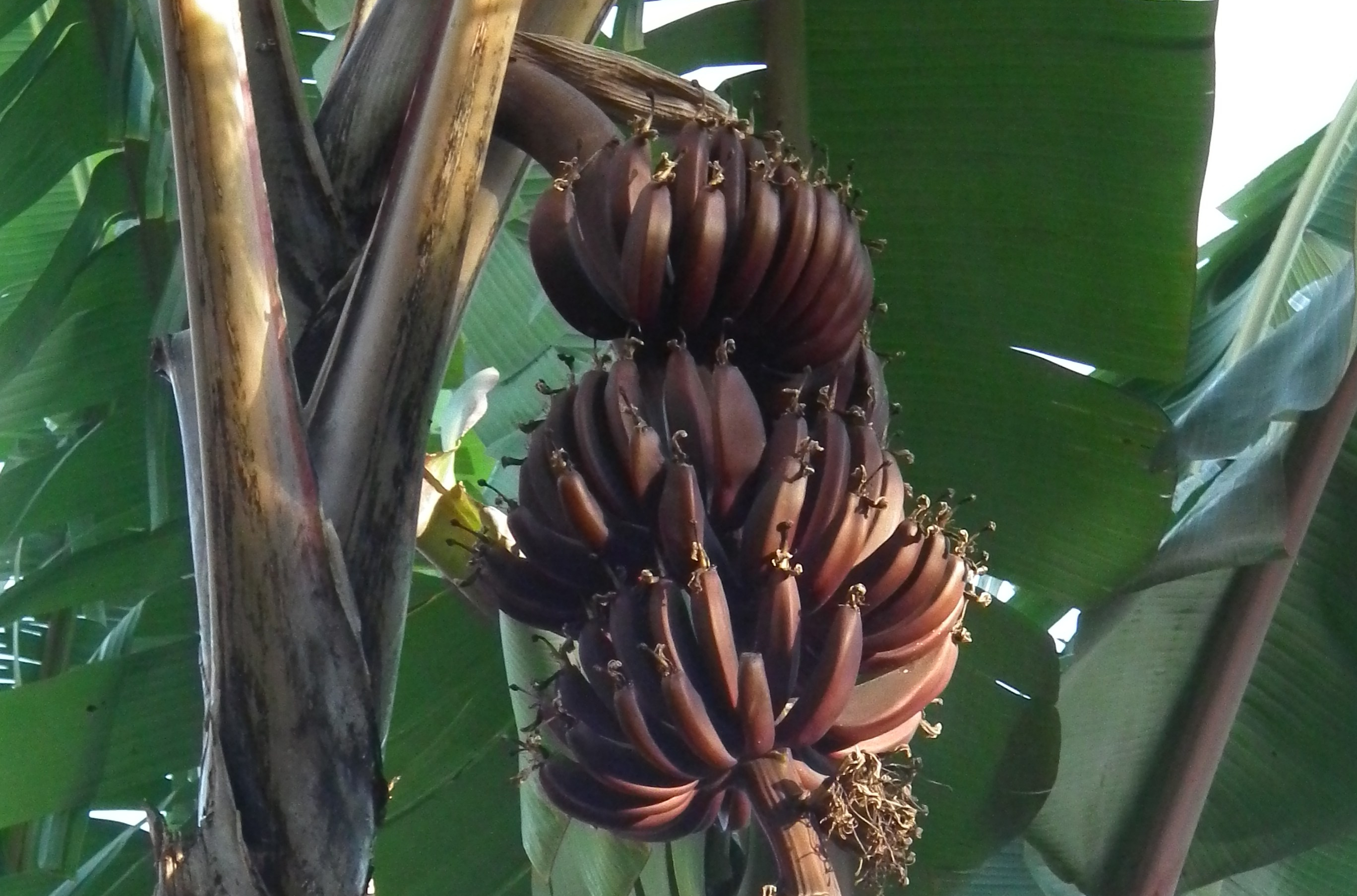
John McAree says the first bananas to appear on the market in Toronto, in the 1870’s and 1880’s, were also red bananas (or pink, or purple if you like). However, it seems bananas have a thing against being commercialized. Throughout their commercial history, bananas have been haunted by drama. Why? Because unlike ‘real’ fruits, bananas are technically more like herbs that do not necessarily stem from two different parents, but are usually planted as clones from one and the same. And like in any monoculture, the lack of genetic variability makes them vulnerable to invading predators, fungi, viruses and bacteria. Kill one, kill all.
First time they were hit by public tragedy was in the 1950’s, when the commercial production of the then-popular Gros Michel banana was roughly wiped out by the Panama disease. As the Gros Michel was the only type of banana eaten in the United States from the late 19th century until after World War II, the hunt was on for a type which was believed to be immune to the disease: the Cavendish, which is flooding modern supermarkets these days. Yet, researchers like Dr Gert Kema warn, now Cavendish is due to die of … the Panama disease, a.k.a. the Fusarium fungus, which managed to develop a new strain that is capable of killing the Cavendish too.
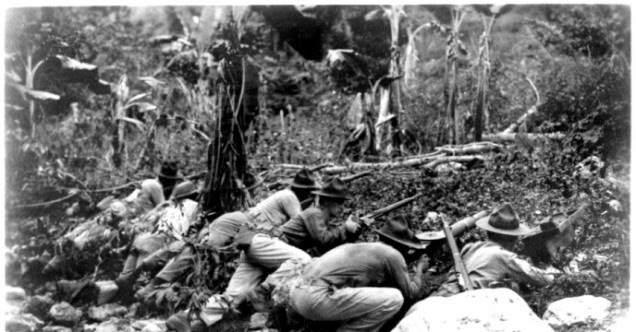
Still, death by disease is not the only scarf on the banana (pseudo)stem. Their name has been associated with banana republics and the banana wars that followed after Latin American banana workers started a kind of a-priori civil rights movement to get paid for their work and educate their families. As they disobeyed US companies such as the United Fruit Company, the American military stepped in to protect their interest. They first intervened in 1846, to intensify their presence after the Watermelon War of 1856 and stay ’till the mid 1930’s, affecting countries including Panama, Cuba, Puerto Rico, Dominican Republic, Nicaragua, Mexico, Haiti and Honduras (which writer O. Henry later dubbed “Banana republic”, starting a metaphor for politically unstable countries that depend on the exportation of a limited-resource product, like bananas).
So, is the wild red banana the super-banana gonna save all? Many of its kind not so wild after all, as the musa acuminata was one of the first to be domesticated by humans for agriculture, in Southeast Asia around 10.000 years ago. But yes, it is a pioneer, that rapidly exploits disturbed areas like after a forest fire, and it in some ecosystems it is considered a ‘keystone species’ that paves the way for greater wildlife diversity – including fruit eating bats, birds, squirrels, tree shrews, civets, rats, mice, monkeys and apes that help spread their seeds. And no, they grow in a way that makes it very difficult for its male flowers to self-pollinate its female ones, and as said: being related to the Panama-prone Cavendish, it is likely to fall prey to the same fungi.
If we want to keep on eating bananas, Dr Kema suggests, we need to find a new banana that is resistant to the disease ánd genetically diverse. But what if it is not the banana, but us that need to change? Start paying local people to maintain their naturally bio-diverse forests and harvest them responsibly, rather than chopping down rain forests, creating large plantations and ’employing’ people at sub-minimum wages, intoxicating them with pesticides and invading their lands. Musa Acuminata is calling on us: for millenniums it’s been nurturing us, now it is time to nurture it.
Sources/Read more:
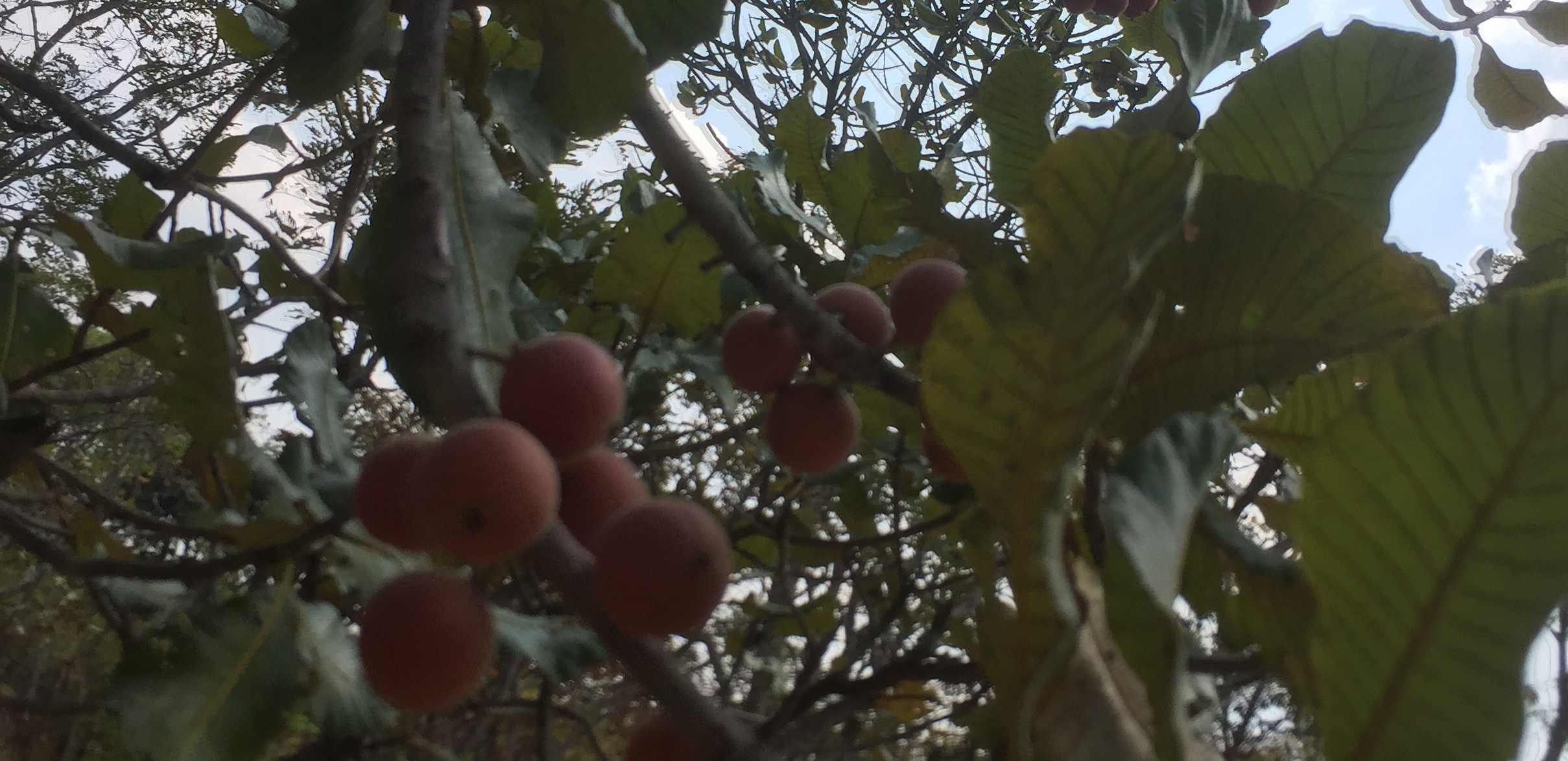
This is one of our latest assets: a fruiting Musuku, at full glory, at our new garden in Chilonga, Zambia. Otherwise known as the ‘Uapaca kirkiana’, ‘sugar plum’, ‘mazhanje’, ‘chilundu’, ‘muhaka’, ‘kabofa’, ‘mazanje’, umhobohobo’, ‘mpotopoto’, ‘mahobohobo’ or simply ‘nsuku’, its thirty+ varieties are amongst the most popular wild fruits of Central, Eastern & Southern Africa. Not only do they provide a rich source of nutrition in places where food production can be generally poor, it’s also an appreciated source of fodder, honey, dye, cockroach repellent, wrapping materials, timber, charcoal and medicine.
Whereas ‘musuku’ is the name of the tree, its fruits are called ‘masuku’. Eaten fresh, pounded into a drink or turned into a jam, butter, wine or syrup, they are one of the most popular fruits of the Miombo woodlands. Hundred grams of these fresh wild loquats gives you about a remarkable 11.8 mg of iron, joining forces with a extra-ordinary 16.8 mgs of vitamin C. Plus a 123 Kcalories, 0.3 grams of protein, 0.4 grams of fat, 2.1 grams of fibre, 17 mg of calcium, 39 mg of magnesium, 15 mg of phosphorus, 375 mg potassium and 10 mg of sodium. Yet, they are mostly liked for their juicy bite and sweet beautiful taste.
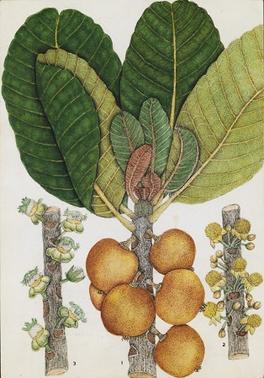
Plate depicting Uapaca kirkiana Müll.Arg. from “Trees of Central Africa” (1956)
The fruits grow on female trees of 5–13 meters with dark green, glossy leaves which are hardly ever attacked by pests, in areas with over 600 mm of rain per year. As they prefer well drained sand or soils low in organic matter, their presence indicates a poor agricultural soil. Yet, their presence will help improve the agriculture underneath as it helps preserve the soil it grows on. It is useful in watershed management, provides good shade and forms a mutual association with the mycorrhizae that help other species develop well.
Besides providing fruits, the Musuku has other ways of providing food for people and animals: ashes from its wood are used for seasoning food, its flowers are valuable for honey production and its leaves are used as fodder for livestock, and are eaten by the bug ‘Encosternum delegoruri’, an important source of protein and money. If you want to eat the bug, and not have the bug eat (all of your) tree, you may want to harvest a few.
Apart from being eaten, its broad leaves are als used as wrappers for storage of processed food and are used as a cockroach repellent in homes. The roots are used to make a blue dye, and an infusion to treat indigestion and dysentery. Perhaps unfortunately, the red wood of the masuku provides a good red fairly termite resistant timber as well as a good source for charcoal, too. To preserve this important tree from being chopped down, it’s worth realising it needs to develop about ten years before it gives its full harvest of fruits. By that time, sales of its fruits will far outweigh the short term financial gains from prematurely taking its woods.
‘I can come to no other conclusion than that Dr. Livingstone is out of his mind
and a most unsafe leader’, Sir John Kirk 1862
As usual, the tree has been known to local people long before it was named by Western recognised botanists. They derived ‘Uapaca’ from the Malagasy name ‘voa-paca’ used for the Madagascar species; U. thouarsii, which was the 1st member of the genus to be scientifically described by Ballion. The specific epithet ‘kirkiana’ was given in honour of Sir John Kirk (1832-1922), explorer and naturalist, and companion to explorer David Livingstone, whom he did not highly recommend. ‘I can come to no other conclusion than that Dr. Livingstone is out of his mind and a most unsafe leader’, he wrote in 1862.

Sir John Kirk in 1908 (December 19, 1832 – January 15, 1922)
Kirk later became a British administrator in Zanzibar, where he was allegedly instrumental in ending the slave trade. Apart from the masuku, his name was also given to a lizard (the Agama kirkii), an amphibian (Kirk’s caecilian, Scolecomorphus kirkii) and a monkey – the Zanzibar red colobus, a.k.a. ‘Kirk’s red colobus’ (Procolobus kirkii).
Sources:
Photo: Masuku fruiting in our Chilonga garden, September 2017, by Desh Chisukulu
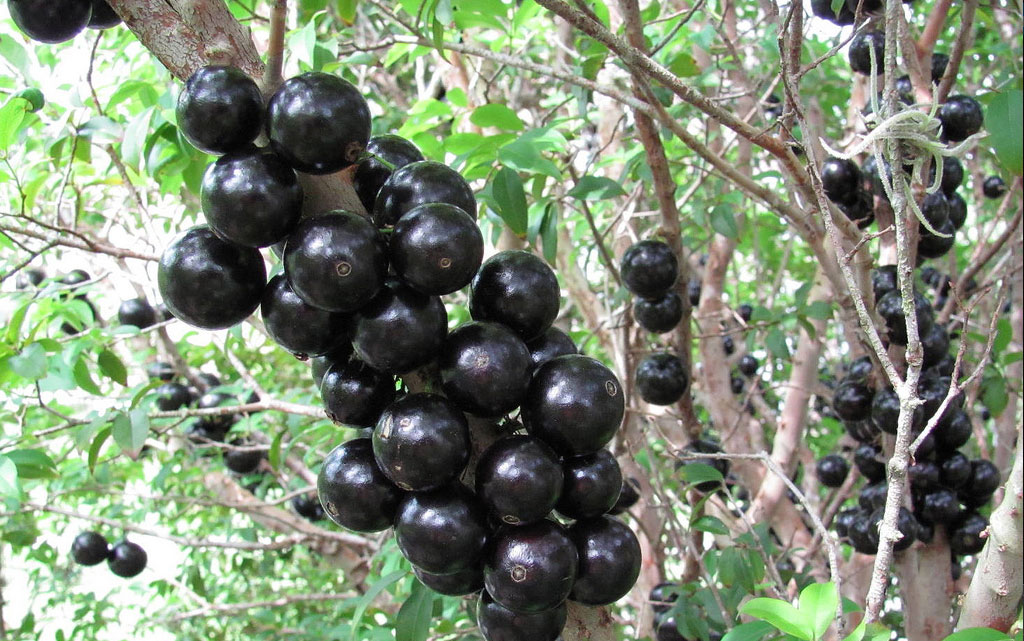
Have you ever seen a tree that grows its fruits straight on its trunk? Check out the Plinia cauliflora, a.k.a. the jabuticaba, a.k.a. the Brazillian grapetree* – which kind of gives away what its fruits taste like. With few growing requirements and a harvest that may come up to three times a year, this tree makes a beautiful and productive container specimen.
The tree prefers moist, rich, lightly acidic soil, but as long as you tend and irrigate it, it can even grow on alkaline beach-sand type soils. Just avoid getting it in touch with salt, as it will vanish. Several varieties can withstand a bit of frost, but commercial cultivation of the fruit in the Northern Hemisphere is restricted by its extremely slow growth – behaving a bit like a nut. Grafted plants may bear fruit in 5 years, seedlings can take up to twenty.
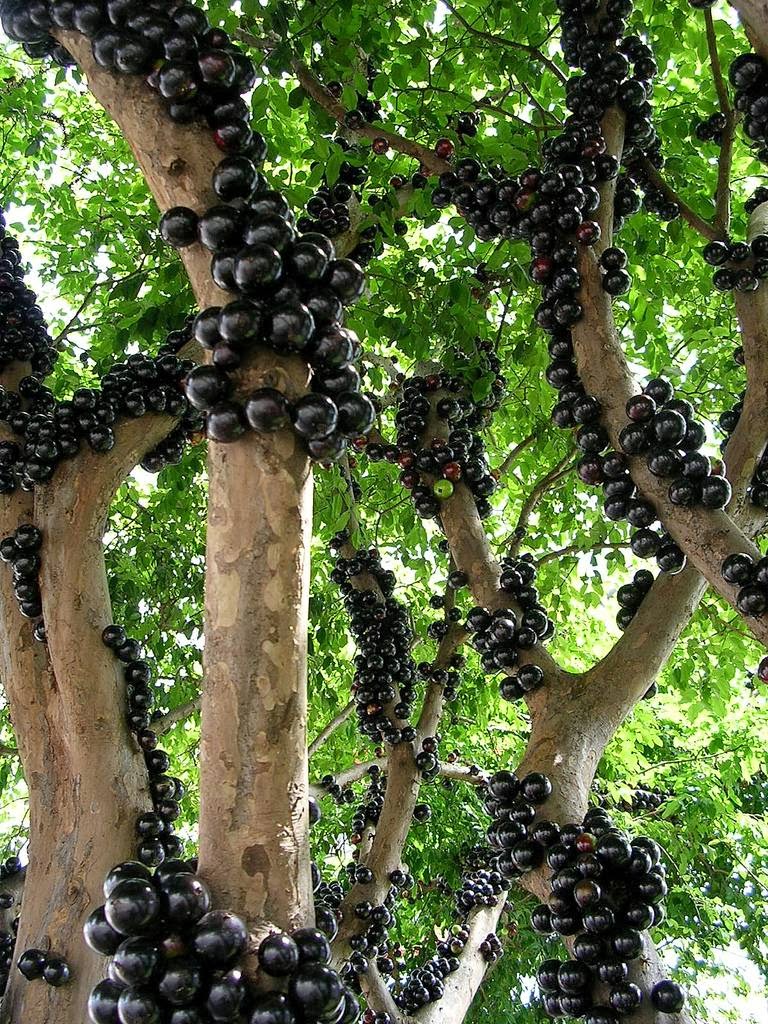
Though it is such a slow-growing evergreen, which may take decades to reach its 15 metres, be warned its fruits are quick! They only take thirty days from flower to fruit, and when they’re ripe you should eat them quickly. Fresh fruit may begin to ferment 3 to 4 days after harvest, so if you have too many, use them to make jams, tarts or drinks.
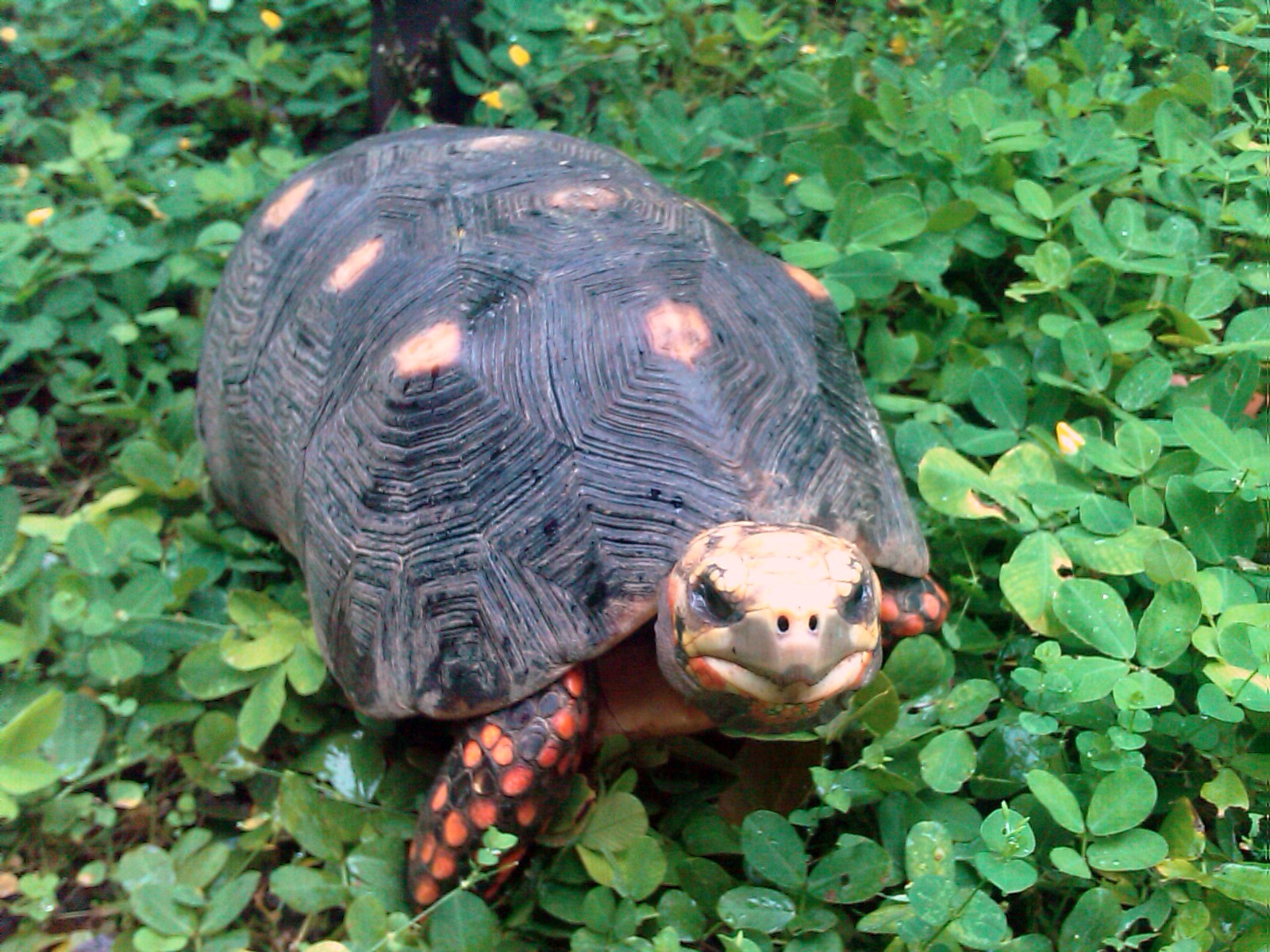
The name jabuticaba, comes from the extinct Tupi words ‘jabuti’ (a red footed tortoise) + ‘caba’ (place), so its the place where you find red footed tortoises, which prefer to live natural habitat ranges from savannah to forest edges around the Amazon Basin. Scholars believe that the ancient Tupi initially lived in the Amazon rainforest, but started to spread southward and gradually occupied the Atlantic coast 2900 years ago, where they came across the first Portuguese that are known to have arrived there.
As tortoises have been classified to be holy animals, carrying resemblances of ancient calenders on their backs, being near a jabuticaba might have suggested good fortune. Unfortunately, the fate of the Tupi did not turn out so well. In 1500, their population was estimated at 1 million people, yet after colonisation, many were assimilated, enslaved or killed by diseases like smallpox. It led to their near complete annihilation, with the exception of a few isolated communities that are confined to Indian reservations or acculturated into the dominant society.
*: and the list goes on, the Jabuticaba is also known as the Jaboticaba, Guaperu, Guapuru, Hivapuru, Sabara, Ybapuru or Myrciaria cauliflora
Sources:
Photo’s:
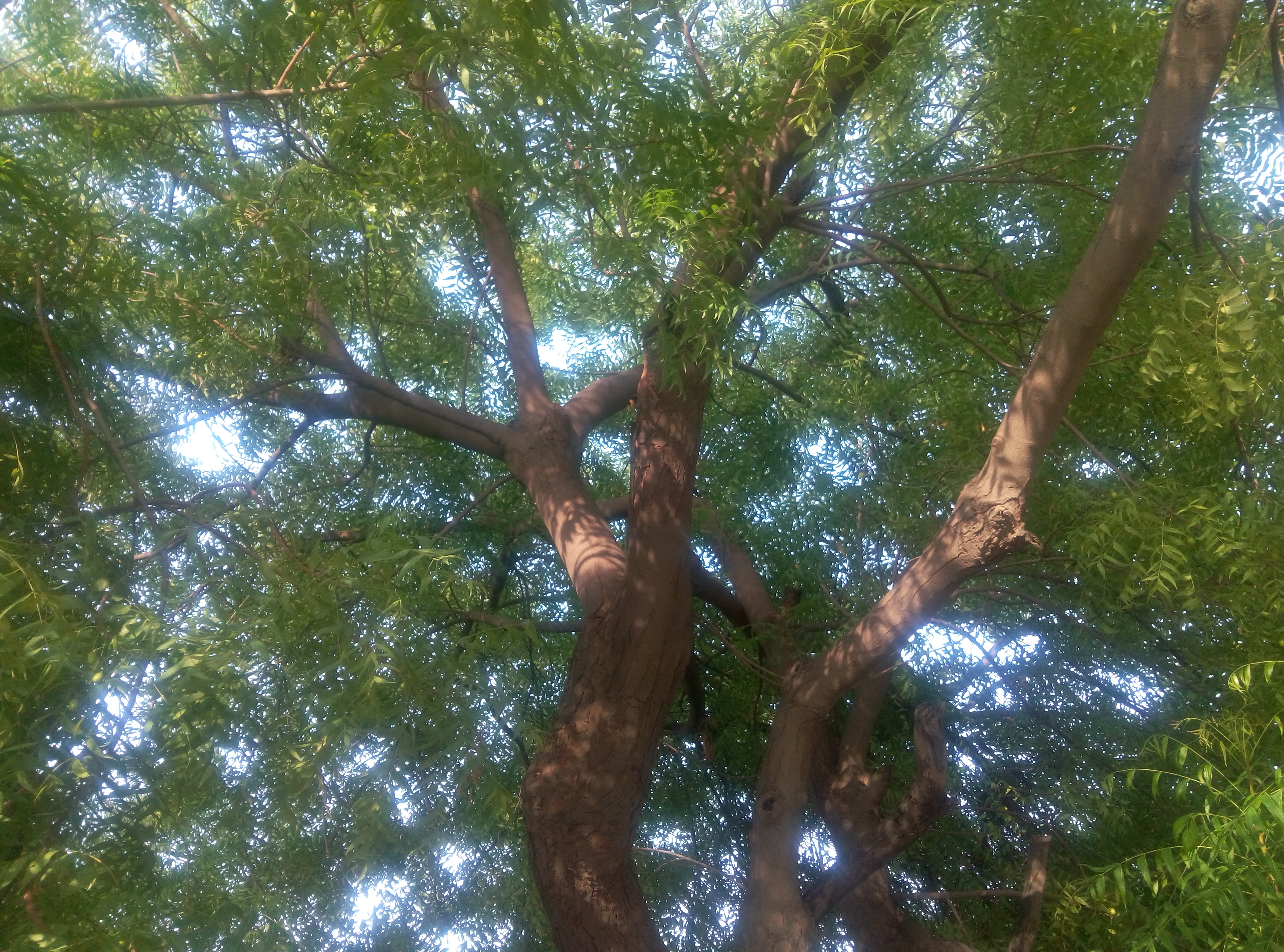
True, the neem tree is not always primarily used as a fruit tree, yet it holds a lot of treasures. The Indians have long regarded it as a holy wonder tree, as they know it to be a source of health for villages whose inhabitants know how to use it. As one of the world’s most researched trees, many of the things local people have known for thousands of years, are currently being verified by modern day scientists. Besides its use as a source of food, pest control, repellent and fodder, it is said to cure over a hundred diseases.
use in reforestation, urban forestry & agro-forestry
The neem grows so well, it is often considered a weed. As it grows on dry wastelands, producing a large amount of shade, roots and biomass, it is a tree that can help fight desertification and erosion. It is a fast growing evergreen, though in severe drought it may shed its leaves. Hence, the neem is recommended for reforestation of semi-arid regions in India and tropics of the sub-Saharan region, Asia and Central America. Its ability to withstand air and water pollution as well as heat, makes it useful for urban forestry. And as it also helps to restore and maintain soil fertility, it can be suitable for agro-forestry as well.
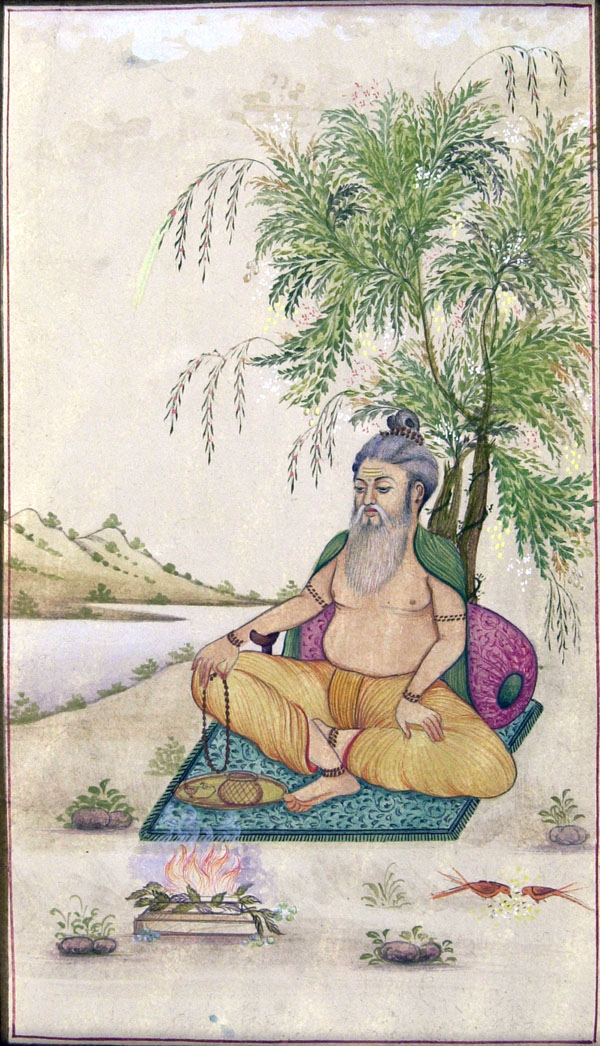
effective mosquito-repellent?
Various studies have been done to test the efficiency of using neem as a mosquito- repellent, but the outcomes seem to vary. The US National Library of Medicine
National Institutes of Health have compared neem to other natural repellents, and concluded burning the leaves can give a 76% protection for 2 hours, whereas using 1% neem oil volatilized in a kerosene lamp would give 94,2% protection from the Anopheles mosquitos that spread diseases like malaria and 80% protection from Culex species that carry infections such as West Nile virus, Japanese encephalitis, filariasis and avian malaria.
MELIACEAE |
|||||||
Azadirachta indica |
IndiaSri LankaChinaBrazil BolíviaPakistanEthiopiaGuinea BissauKenyaTanzania (…) |
Neem |
azadirachtinsaponins |
direct burning (leaves) |
76.0% protection from mosquitoes for 2 hours |
field study in Guinea Bissau |
[99] |
periodic thermal expulsion (leaves) |
24.5% protection from An. gambiae s.s |
semi-field study in Kenya |
[50] |
||||
1% neem oil volatilized in a kerosene lamp |
94.2% protection from Anophelesspp.80% protection from Culex spp. |
field study in India |
[109] |
||||
2% neem oil applied topically |
56.75% protection from mosquitoes for 4 hours |
field study in Bolivia |
[35] |
Those who want a 100% protection against the feared Aedes aegypti mosquito (carrier of diseases like dengue fever, chikungunya, Zika fever, Mayaro and yellow fever) might be better off looking for extracts of the lemon bush (Lippia Javanica), lemon eucalyptus or citronella grass.
Sources:
Picture: ‘Neem tree under shade at evening’ by Vershita yadav (Own work) [CC BY-SA 4.0 (http://creativecommons.org/licenses/by-sa/4.0)], via Wikimedia Commons